
Learn/Electronics
Electronics
Electronics is how a robot knows anything about the room. Students meet switches, motors, and sensors on a low-voltage kit, with an instructor at the table. The point is to connect the kit to machines they already know.
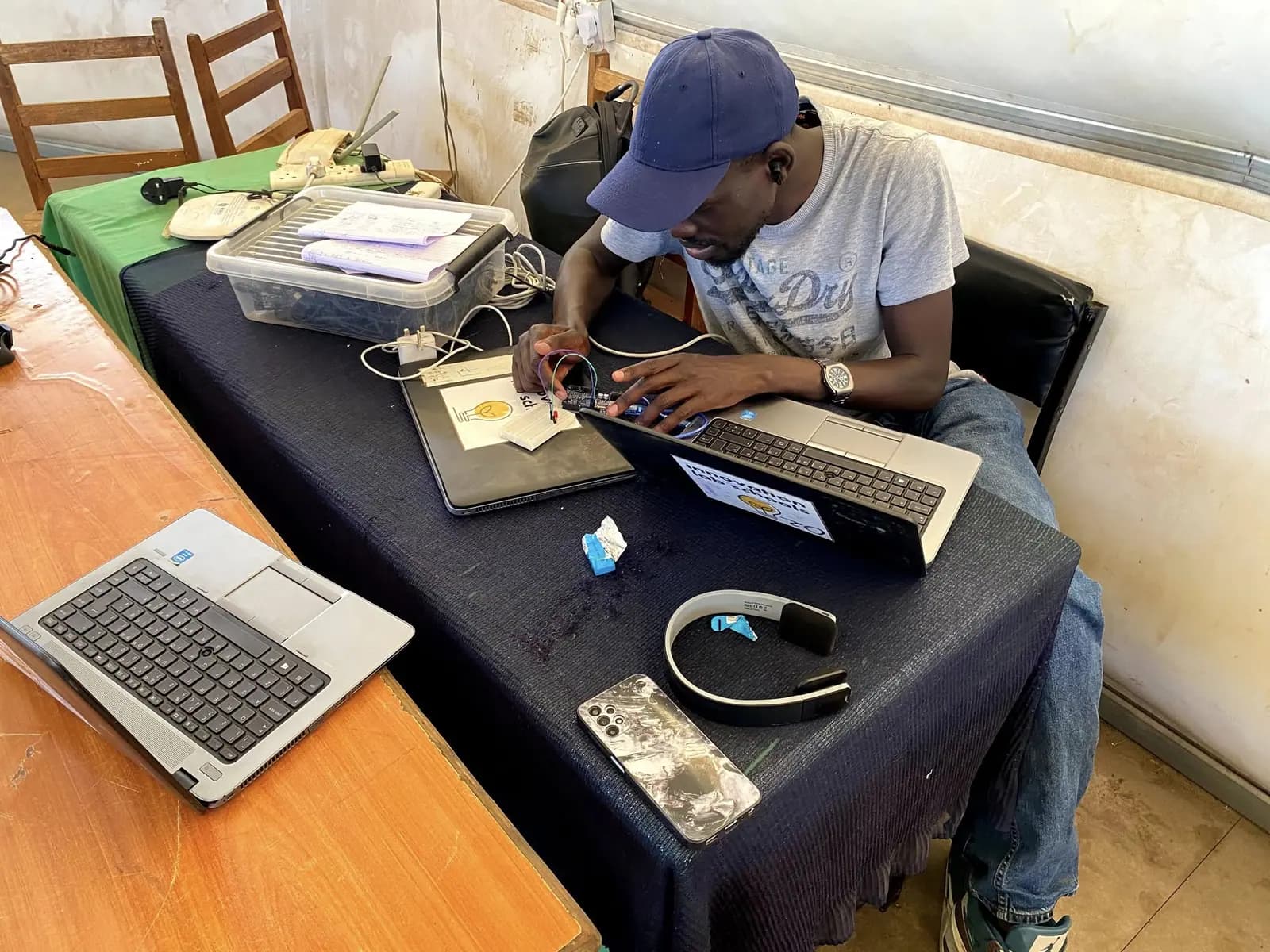
Who it is for: From about age 8, inside the robotics class
It involves
- A closed circuit
- Sensors as inputs
- Motors, lights, and buzzers
- Low-voltage kits only
A path they can trace
Power leaves a source, passes through a component, and returns. An open path is something the student can find.
Input and output
A sensor is an input. A motor, light, or buzzer is an output. The program in the middle is a decision.
One change at a time
When a circuit fails, students change one connection and test again.
A link to machines they know
In the April 2024 Voi classes, Francis Monaja connected the kits to ordinary machines such as an alarm and a fridge. Students still do not open household wiring.
From the kit to the kitchen
During the April 2024 holiday classes at P.C.E.A. St. Stephen’s Academy in Voi, instructor Francis Monaja used the sessions to connect robotics with ordinary machines, including an alarm and a fridge. That is still the standard we use. A sensor on a robot should remind a student of a sensor in a house.
Students practice on classroom kits only. They do not open household wiring, and they do not work with mains electricity. If a project needs a tool or a battery handling step, the instructor does that part.
Ideas a student should be able to show
A closed path
Power leaves a source, passes through a component, and returns. If the path is open, nothing happens, and the student can find the gap.
Input and output
A sensor is an input. A motor, light, or buzzer is an output. The program in the middle is a decision.
One change at a time
When a circuit fails, students change one connection, test again, and write down or say what they changed. Guessing at three things at once is treated as a failed method, not as speed.
Questions
Do students work with mains electricity?+–
No. Practice stays on classroom kits. If a step needs a tool or a battery handled by an adult, the instructor does that part.
Is electronics its own course?+–
It sits inside robotics. There is no separate wiring qualification.